The State of AI Revolution
A comprehensive data story of transition and transformation (2020-2026)
📖 The AI Journey
The pandemic accelerated digital transformation. Early adopters in tech and finance experimented with AI for automation and remote work solutions. Adoption was cautious but purposeful, with enterprise AI adoption around 15-22%.
ChatGPT and generative AI captured public imagination, triggering explosive growth across all sectors. GenAI reached 100 million users in just 2 months—the fastest adoption of any technology in history. Enterprise adoption surged to 55-65%.
Companies moved from experimentation to strategic integration. ROI became measurable, and AI transformed from competitive advantage to business necessity. By 2026, 94% of enterprises use AI, with 40% of workflows becoming autonomous.
🔑 Key Insights
Fastest Tech Adoption Ever
GenAI reached 100M users in 2 months vs. 75 years for telephone
Universal Enterprise Adoption
94% of major enterprises now use AI in some capacity
Productivity Revolution
Average worker saves 12.5 hours/week through AI automation
Shift to Autonomous
40% of workflows now run autonomously via AI agents
Adoption Trends
Historical AI adoption patterns and growth trajectories
📊 Adoption Milestones
2022: Inflection Point
Adoption hit critical mass and growth became exponential
2024: Mainstream
AI became standard business infrastructure, not competitive edge
2026: Saturation
94% enterprise adoption—focus shifts to optimization
Sector Analysis
Industry-specific AI adoption and performance
| Industry | Adoption Rate | Usage Frequency | Perceived ROI | Integration Gap |
|---|
Global View
Geographic distribution and regional perspectives on AI
🌏 Regional Insights
North America: 72% Adoption
Leads global AI adoption with strong enterprise and startup ecosystem
Asia Pacific: 65% Adoption
Rapid growth driven by China, Japan, and emerging tech hubs
Europe: 58% Adoption
Strong regulatory focus with balanced AI governance approach
Emerging Markets: Growing Fast
Middle East (42%), Latin America (38%), Africa (22%) - high growth potential
Use Cases
How organizations are applying AI across different functions
💡 Use Case Insights
Customer Service Leads: 28%
AI-powered chatbots and support systems dominate enterprise adoption
Data Analytics: 24%
Business intelligence and predictive insights drive strategic decisions
Process Automation: 20%
Workflow automation delivers consistent ROI across industries
Content Generation: 15%
Text, image, and code generation streamline creative workflows
Impact & ROI
Measuring the business value of AI investments
📊 ROI Insights
Majority Achieving Strong ROI
57% of organizations report 25%+ ROI from AI investments
Top Performers Excel
7% of companies achieve exceptional 100%+ ROI on AI
Data Quality #1 Challenge
75% of organizations cite data quality as their biggest barrier
Investment Surge: $184B
Total AI investment grew 52% YoY, reflecting confidence in returns
🔮 Looking Forward: 2030 Projections
Projected global economic impact of AI by 2030 — representing one of the largest economic shifts in modern history.
Most jobs will change rather than disappear. Focus shifts from replacement to human-AI collaboration.
Expected number of people using AI tools daily by 2028, up from hundreds of millions today.
Nearly half of all workers will need significant reskilling as AI transforms job requirements across industries.
Workforce Impact
How AI is transforming jobs, skills, and workplace dynamics
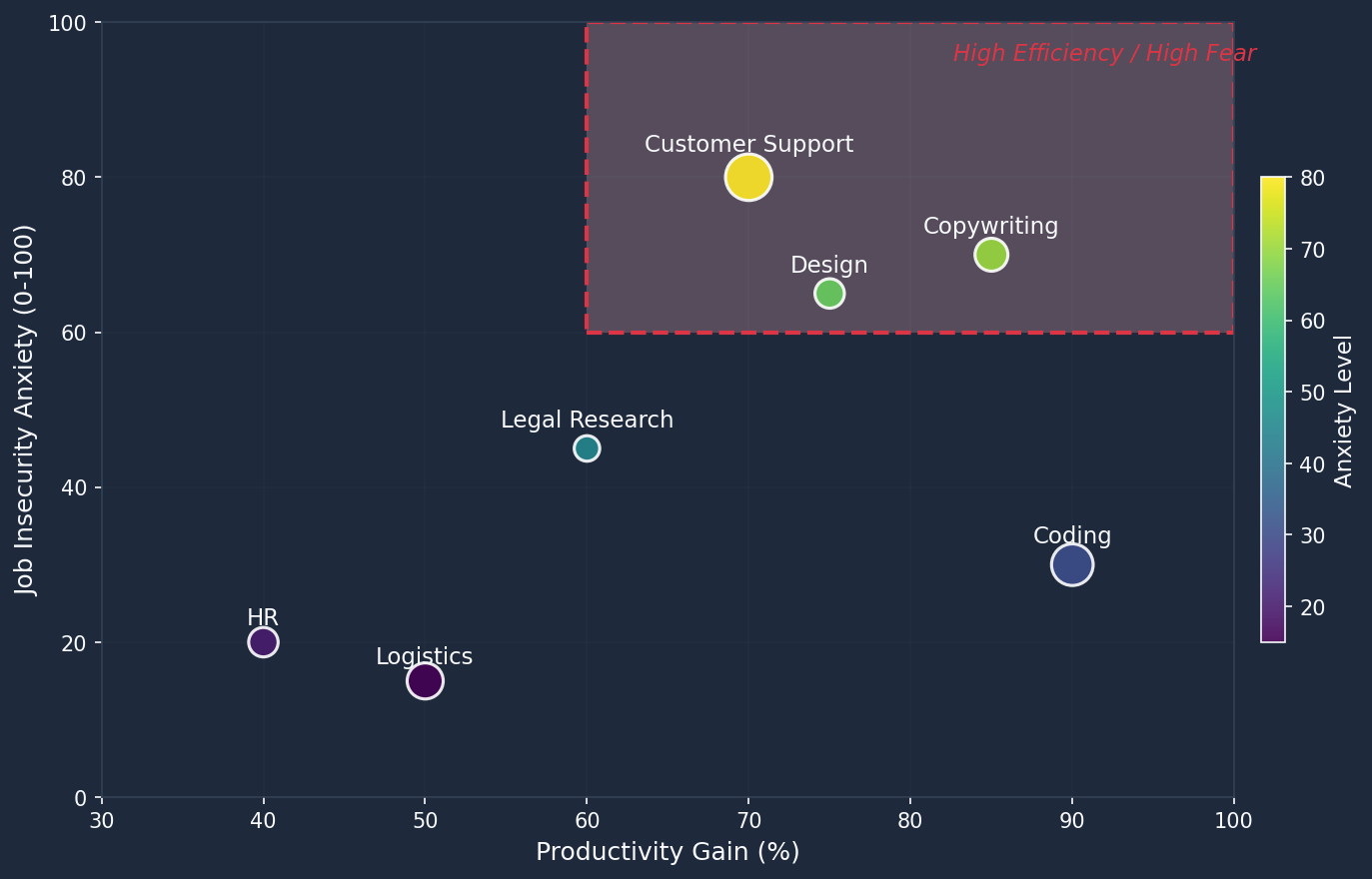
| Department | Productivity Gain | Job Anxiety | Risk Level |
|---|
👥 Workforce Insights
Copywriting & Support at Risk
High productivity gains (70-85%) correlate with highest anxiety (70-80%)
Coding: The Exception
90% productivity gain but only 30% anxiety—AI seen as collaborator
Net Positive Jobs
97M new jobs vs 85M displaced = +12M net employment
Fendry's Perspective
Strategic insights on AI transformation based on industry observations and collective analysis | Q1 2026
🌐 Digital Transformation Milestones
The Internet established the foundational infrastructure for digital transformation, creating unprecedented connectivity and information access that reshaped business operations globally.
Smartphones and mobile computing ubiquitously expanded digital connectivity and access, enabling real-time communication and computing power in every pocket.
COVID-19 served as an unprecedented catalyst, rapidly accelerating the necessity for global digital adoption and fundamentally changing work paradigms.
Artificial Intelligence is currently propelling the subsequent wave of digital transformation, representing a paradigm shift in how organizations operate, innovate, and compete.
Rapid proliferation of search engines provided diverse information retrieval options, though results varied significantly across competing platforms.
Obtaining accurate, reliable, and comprehensive information coverage proved challenging, requiring users to cross-reference multiple sources.
Information exchange was impeded by widespread skepticism towards early online publishing and content authenticity.
Rapid proliferation of generative AI applications offers diverse content generation capabilities across text, code, images, and multimodal outputs.
Achieving identical outputs for the same input is probable but not guaranteed. Ensuring factual reliability and verifiable information remains a significant challenge.
Information oversharing and data leakage on the internet are exacerbated by a lack of robust enforcement mechanisms.
🛡️ AI Safety
Ensuring AI systems operate within intended parameters, preventing unintended consequences and maintaining alignment with human values and organizational objectives.
🔒 AI Security
Protecting AI systems from adversarial attacks, data breaches, and malicious exploitation while ensuring robust access controls and threat mitigation strategies.
📊 AI Data Quality
Maintaining high-quality, representative, and unbiased training data to ensure reliable outputs and minimize systematic errors in AI-generated content.
The Intersection: Powerful AI
When Safety, Security, and Data Quality converge, organizations achieve AI systems that are simultaneously safe & secure, deliver reliable operations, and provide consistent performance.
Content Safeguards
AI systems require robust safeguards to prevent the generation of content that promotes or facilitates harmful activities. How do we balance capability with responsibility?
Dual-Use Information
How should AI models be configured to address inquiries that are not inherently harmful but involve sensitive or dual-use information? Defensive research often requires access to offensive knowledge.
Intellectual Property Rights
What mechanisms are necessary to ensure AI platforms respect and protect intellectual property rights, including ownership and copyright, during content generation and information retrieval?
📋 Proposed: Integrated AI Governance Framework
Constitutional AI Enhancement
A dedicated governance enforcement layer overlying Constitutional AI (CAI) to ensure systematic safeguards against sensitive, dual-use inquiries.
Strategic Principle Responses
AI responses limited to high-level strategic principles, strictly preventing disclosure of classified information or specific vulnerabilities.
Information Boundary Controls
Robust mechanisms to prevent disclosure regardless of whether such information exists elsewhere, maintaining consistent safety standards.
Continuous Evaluation
Ongoing assessment through observations, case studies, and focus groups to refine governance approaches as AI capabilities evolve.
"These perspectives represent individual and collective insights gathered through industry observation, technical analysis, and stakeholder engagement. They are intended to contribute to the broader discourse on responsible AI development."
— Fendry Utama | Q1 2026